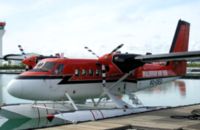
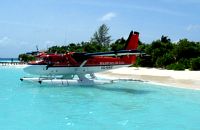
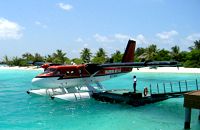
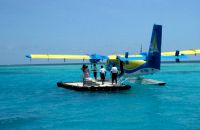
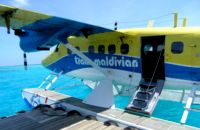
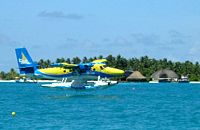
Trans Maldivian Airways (TMA) has 14 years of experience and professionalism in inter-island air transport within the Maldives. TMA also operates a large fleet of Twin Otters for transportation between the islands and resorts of the Maldives.
Described as the ‘little workhorses of the skies’, Twin Otters are known for their rugged construction and Short Take Off and Landing (STOL) performance. Also known as a DHC-6 in its civilian version, the De Havilland Twin Otter is a highly manoeuvrable, versatile aircraft that can be flown slowly (80-160 knots/150-300 kph) and in tight circles. It is a high wing, twin engine, and turbo prop aircraft capable of carrying up to twenty passengers in the commuter role. It has a wingspan of 65 ft, a length of 51 ft 9 in and a maximum take-off weight of 12,500 lbs.
The history of the Twin Otter begins at De Havilland’s first manufacturing plant in Toronto. On 5 March 1928, De Havilland Canada (DHC) was incorporated as a subsidiary of the British De Havilland Aircraft company. Britain wanted Canada to develop a strong airforce, so DHC went to work producing Moth aircraft for the Royal Canadian Air Force (RCAF). The company first produced the Moth aircraft for the British. After the Second World War, DHC began producing the Chipmunk all-metal trainer, which was successfully sold in Canada and internationally. Chipmunks are still in use today. Then came the very rugged Beaver and the single-engine Otter. The need for a hardier, twin-engine aircraft resulted in the highly successful Twin Otter.
Today, the Twin Otter is used all over the world, in places where small, hardy aircraft are needed for various purposes. Equipped with wheel and ski combinations, they are the backbone of many Antarctic operations and are fitted with specialist equipment including magnetometers, ice depth radio echo sounders, gravimeters, ocean colour sensors, specialised cameras, mapping equipment, military-specification sonar, radar and scanning devices. The Twin Otter offers itself as a very stable and highly manoeuvrable platform for geological survey operations and military applications. Additionally equipped with floats, they serve as commuter planes, tourist transport and even as mobile health service units.
In the Maldives, the Twin Otter has come into its own as the safest, fastest and most reliable form of travel between its many islands.